|
Great Backyard Bird Count Highlights
Dynamic Changes in Where the Birds Are
Bird
watchers break record for fifth straight year
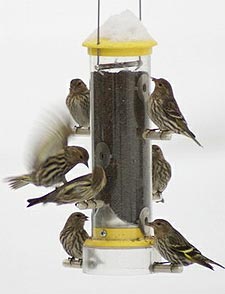 New York, NY & Ithaca, NY—The 12th annual Great Backyard Bird Count (GBBC) featured
two invasions this year: voracious Pine Siskins (pictured right) and a
whole new crop of citizen-science participants! Bird watchers shattered
last year's record by submitting more than 93,600 checklists
during the four-day event, held February 16-19. Participants also
identified 619 species and sent in thousands of stunning bird images
for the GBBC photo contest. The Great Backyard Bird Count is led by the
Cornell
Lab of Ornithology and the National
Audubon Society. New York, NY & Ithaca, NY—The 12th annual Great Backyard Bird Count (GBBC) featured
two invasions this year: voracious Pine Siskins (pictured right) and a
whole new crop of citizen-science participants! Bird watchers shattered
last year's record by submitting more than 93,600 checklists
during the four-day event, held February 16-19. Participants also
identified 619 species and sent in thousands of stunning bird images
for the GBBC photo contest. The Great Backyard Bird Count is led by the
Cornell
Lab of Ornithology and the National
Audubon Society.
"Each year the GBBC provides the most detailed real-time snapshot
of bird distribution across North America," said Rob Fergus,
Senior Scientist with the National Audubon Society. "We can see
how birds are responding to changing weather patterns, available food
sources, and other factors from around the continent."
One of the big stories coming from the GBBC this year was the massive
invasion of Pine Siskins and White-Winged Crossbills over much of the
eastern United States. These feisty little birds moved southward
because of seed crop failures in their usual wintering grounds in
Canada and the boreal forests. GBBC participants reported 279,469 Pine
Siskins on 18,528 checklists, compared to the previous high of 38,977
birds on 4,069 checklists in 2005. White-winged Crossbills were not as
common, but their invasion was still impressive with 4,824 birds on 589
checklists representing a new record over the previous high of 2,854
birds on 135 checklists in 2007.
The GBBC continues to show declines in some common birds, especially
grassland and shrubland species. Loggerhead Shrike numbers are down,
and although numbers of Northern Bobwhites and Eastern Meadowlarks were
both up slightly from last year, they are still being reported in fewer
numbers during the GBBC than they were in 2004. These GBBC trends are
only preliminary views of what may be going on with these populations,
and they must continue to be monitored to get a true long-term view of
how these birds are faring.
Species reported for the first time during the Great Backyard Bird
Count included two oceanic species--Pink-footed Shearwater and Xantus's
Murrelet, both in California. Other first-timers included Baird's
Sandpiper, Black-billed Cuckoo, and Blackpoll Warbler. Two rare Mexican
species appeared on GBBC checklists from Arizona for the first time:
the first Sinaloa Wren ever found north of the border, and a Blue
Mockingbird.
"I just love the way this event opens up a new world for so many
people," says Cornell Lab of Ornithology Citizen Science Director
Janis Dickinson. "We have grandparents counting with their
grandchildren, elementary school classrooms doing the GBBC as a special
project, nature centers taking visitors out on bird walks. And adults
who never noticed birds before are suddenly smitten!"
For a more detailed summary of this year's results, visit the GBBC web
site at www.birdcount.org.
Explore 2009 data, compare with other years, and find the exact counts
for each species in a particular state, province, or town.
The Great Backyard Bird Count is sponsored by Wild
Birds Unlimited.
The next Great Backyard Bird
Count is February 15-18, 2010!
#
Top 10 most-frequently reported birds in the 2009 GBBC:
1) Northern Cardinal
2) Mourning Dove
3) Dark-eyed Junco
4) American Goldfinch
5) Downy Woodpecker
6) Blue Jay
7) House Finch
8) Tufted Titmouse
9) American Crow
10) Black-capped Chickadee
Media Note: Visit the
"Explore the Results" pages on the GBBC web site at www.birdcount.org
to find the list of Top 10 birds reported in your state, province,
or city.
Image: Pine Siskins by Steve Gillespie, West Virginia,
2009 GBBC participant
|
|
The
Cornell Lab of Ornithology is a membership institution dedicated to
interpreting and conserving the earth's biological diversity through
research, education, and citizen science focused on birds. Visit the
Lab's web site at www.birds.cornell.edu.
Audubon is dedicated to protecting birds and
other wildlife and the habitat that supports them. Our national network
of community-based nature centers and chapters, scientific and
educational programs, and advocacy on behalf of areas sustaining
important bird populations, engage millions of people of all ages and
backgrounds in conservation. www.audubon.org
|